
Patient guide to inguinal, umbilical & incisional hernia surgery, recovery timelines, risks.
Around 27% of men and 3% of women will develop a groin hernia at some point in their lives, and roughly 20 million hernia repairs are performed worldwide each year. In Australia, hernia repair ranks among the most frequently performed general surgical procedures.
Dr Naseem Mirbagheri is a general and colorectal surgeon in Melbourne who assesses and repairs abdominal wall hernias. She discusses the available techniques with each patient, explains what the evidence shows, and helps people decide whether surgery suits their circumstances
A hernia occurs when tissue, usually fat or bowel, pushes through a weak point in the abdominal wall. The result is often a visible bulge, sometimes with dragging discomfort, aching or a sensation of heaviness that worsens through the day.
Hernias don’t heal on their own. Some remain small and cause few problems for years. Others enlarge over time. A small proportion become incarcerated or strangulated, where blood supply to trapped tissue is compromised. That situation requires emergency surgery, and it’s one reason symptomatic hernias warrant assessment rather than indefinite waiting.
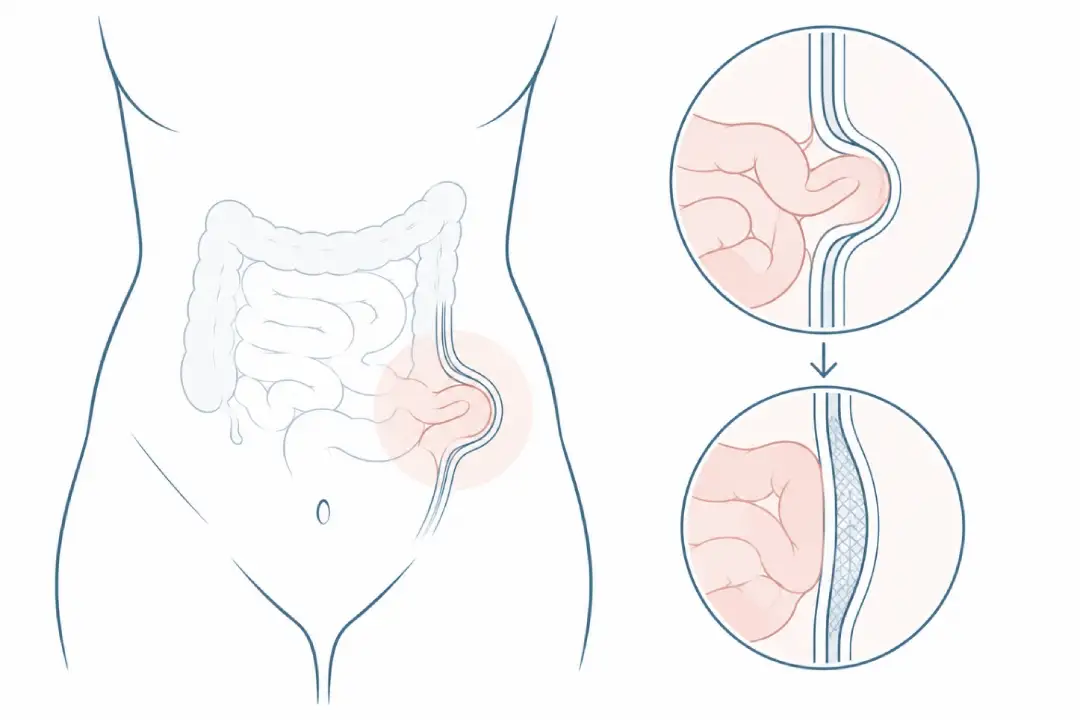
Hernias are named according to where they appear on the abdominal wall, and that location shapes the symptoms, the repair technique and the expected recovery.
These occur in the groin and account for the majority of abdominal wall hernias. They’re far more common in men, largely because of the anatomy of the inguinal canal. Symptoms often include a groin bulge that becomes more obvious on standing or straining, along with aching after physical activity.
Not every inguinal hernia needs immediate surgery. Guidelines support considering watchful waiting for men with minimally symptomatic hernias, though many eventually proceed to repair because symptoms progress. Repair is generally recommended for women with groin hernias, given the higher proportion of femoral hernias and associated complication risk.
These occur in the groin and account for the majority of abdominal wall hernias. They’re far more common in men, largely because of the anatomy of the inguinal canal. Symptoms often include a groin bulge that becomes more obvious on standing or straining, along with aching after physical activity.
Not every inguinal hernia needs immediate surgery. Guidelines support considering watchful waiting for men with minimally symptomatic hernias, though many eventually proceed to repair because symptoms progress. Repair is generally recommended for women with groin hernias, given the higher proportion of femoral hernias and associated complication risk.
These occur in the groin and account for the majority of abdominal wall hernias. They’re far more common in men, largely because of the anatomy of the inguinal canal. Symptoms often include a groin bulge that becomes more obvious on standing or straining, along with aching after physical activity.
Not every inguinal hernia needs immediate surgery. Guidelines support considering watchful waiting for men with minimally symptomatic hernias, though many eventually proceed to repair because symptoms progress. Repair is generally recommended for women with groin hernias, given the higher proportion of femoral hernias and associated complication risk.
Recovery varies between individuals and depends on the hernia type, the approach used and the physical demands of daily life.
Risks of hernia surgery is discussed openly during consultation.
General guidance for uncomplicated repairs:
- Most inguinal and umbilical repairs are day procedures
- Driving usually resumes once patients can brake sharply without pain, often around one week
- Desk based work commonly resumes within 1-2 weeks
- Physical or manual work may need 3-6 weeks
- Gradual return to gym and heavy lifting typically starts at 4-6 weeks
- Incisional and larger complex repairs often need longer, sometimes 6-12 weeks

Dr Naseem performs surgical procedures, including hernia repair, at St John of God and the Epworth hospitals in Melbourne, as well as offering consultations from her offices in Richmond and Berwick. If you believe that Dr Naseem is the right surgeon for your particular case, please contact us today to book an appointment.

For non-urgent cases, a 1-to-2-week appointment time may apply.
This page provides general information only. It isn’t a substitute for individual medical advice. Any surgical procedure carries risks, and outcomes vary between patients. Discuss your own circumstances with a qualified health practitioner.